
Aldi's Strategic Expansion into US Urban Markets
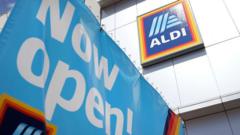
The German discount supermarket chain, Aldi, is embarking on a substantial expansion initiative across the United States, with plans to introduce 800 new stores within a five-year timeframe. This strategic growth, valued at $9 billion, specifically targets dense urban environments such as Manhattan, marking a notable shift from the brand's traditional focus on suburban locations.
A recent opening in Manhattan exemplifies this new direction. Tucked beneath a luxury apartment complex, this Aldi store offers a stark contrast to its upscale surroundings, providing significantly lower prices on everyday essentials. For instance, a jar of almond butter priced at $4 at Aldi can cost as much as $22 in nearby establishments, a difference that has garnered attention from local shoppers like Mary Porter, who expressed surprise at the considerable savings.
Despite its discreet location, the Manhattan store experiences high foot traffic, indicating a strong demand for affordable groceries even in affluent areas. This expansion builds upon Aldi's initial entry into the US market in 1976, which has since grown to nearly 2,800 outlets, demonstrating a sustained commitment to increasing its footprint.
Lessons from the UK Market
Aldi's aggressive expansion in the US draws parallels to its successful market penetration in the United Kingdom. Upon entering the UK market in the 1990s alongside fellow German retailer Lidl, Aldi quickly gained a significant share by offering competitive pricing for quality products. Traditional UK grocers, often referred to as the "big four" (Tesco, Sainsbury's, Asda, and Morrisons), were initially slow to adapt to this new competition. This allowed Aldi to steadily attract customers, eventually becoming the UK's fourth-largest grocer with a 10.8% market share.
The brand's European success was further propelled by a shift in consumer perception, moving beyond its initial image as a strictly low-cost retailer to one recognized for product quality. The cost of living crisis in the 2020s also contributed to its accelerated growth, as consumers increasingly sought value.
Targeting Middle and Higher-Income Consumers
While Aldi's US market share currently stands at 2.9% compared to Walmart's approximately 20%, analysts suggest that Aldi's strategy does not necessarily involve directly competing with retail giants like Walmart on scale. Instead, Aldi appears to be winning by remaining more agile and focused. Data from Placer.ai indicates that Aldi is successfully attracting middle and higher-income shoppers, particularly those with household incomes ranging from $75,000 to $125,000. Persistent inflation has prompted these wealthier households to explore more economical supermarket options.
RJ Hottovy, head of analytical research at Placer.ai, notes that these consumers are increasingly opting for Aldi over conventional grocery stores or quick-service restaurants as they seek ways to optimize their household budgets. This trend suggests a broader appeal beyond its traditional customer base.
Operational Efficiencies and Challenges in Urban Environments
Aldi's business model is characterized by its lean and highly efficient operations. Dustin York, an associate professor of communication at Maryville University, explains that Aldi offers approximately 80% of the product variety found in a typical big-box retailer but at a significantly reduced cost. This efficiency is largely attributed to its heavy reliance on a limited range of private-label products.
However, operating in dense urban areas like Manhattan presents unique challenges, particularly concerning real estate costs. Average asking rents in Manhattan's retail landscape can range from $350 to $700 per square foot, posing a substantial financial hurdle. Furthermore, logistics in such environments are complex. Scott Patton, Aldi's US chief commercial officer, detailed the intricate supply chain for the Manhattan store, which involves trucking inventory from South Windsor, Connecticut. This requires specialized, shorter trucks and a two-driver team to navigate congested city streets and tight turning radiuses, with deliveries typically occurring overnight to mitigate traffic issues. This demanding operation, likened to a "logistical symphony," necessitates three to four such trips nightly to keep the shelves stocked.
Aldi vs. Walmart: A Strategic Contrast
Retail analyst Jerry Sheldon of IHL Group contrasts Aldi's approach with that of Walmart, describing Aldi as a "scalpel" fighting against Walmart's "war chest." Walmart, with its multi-billion dollar annual investments in technology, automation, and supply chain infrastructure, including robots and AI-driven forecasting, operates on a fundamentally different scale. Additionally, Walmart generates substantial revenue from diverse sources like advertising and membership programs, avenues Aldi does not pursue.
Sheldon summarizes this distinction by stating, "Aldi is a brilliant single-purpose machine, while Walmart is a money machine that happens to sell groceries cheaply. That gap is the whole ballgame." While Aldi excels in its focused, cost-efficient model, directly surpassing the retail giant in market share remains a formidable task due to Walmart's immense resources and diversified revenue streams.
Ultimately, for shoppers like Mary Porter, the strategic intricacies of the retail industry are secondary to the tangible benefits of affordability. The ability to purchase groceries at a fraction of the cost significantly impacts her personal budget, making Aldi's presence a welcome addition to her shopping routine.
Source: How Aldi is taking on US supermarkets with its $4 almond butter